

Bilevel Therapy (BiPAP)
Bilevel therapy supports breathing during sleep through a mask, with a higher pressure as you breathe in and a lower one as you breathe out. At Sleepscope, a sleep physician can discuss whether it may suit you.
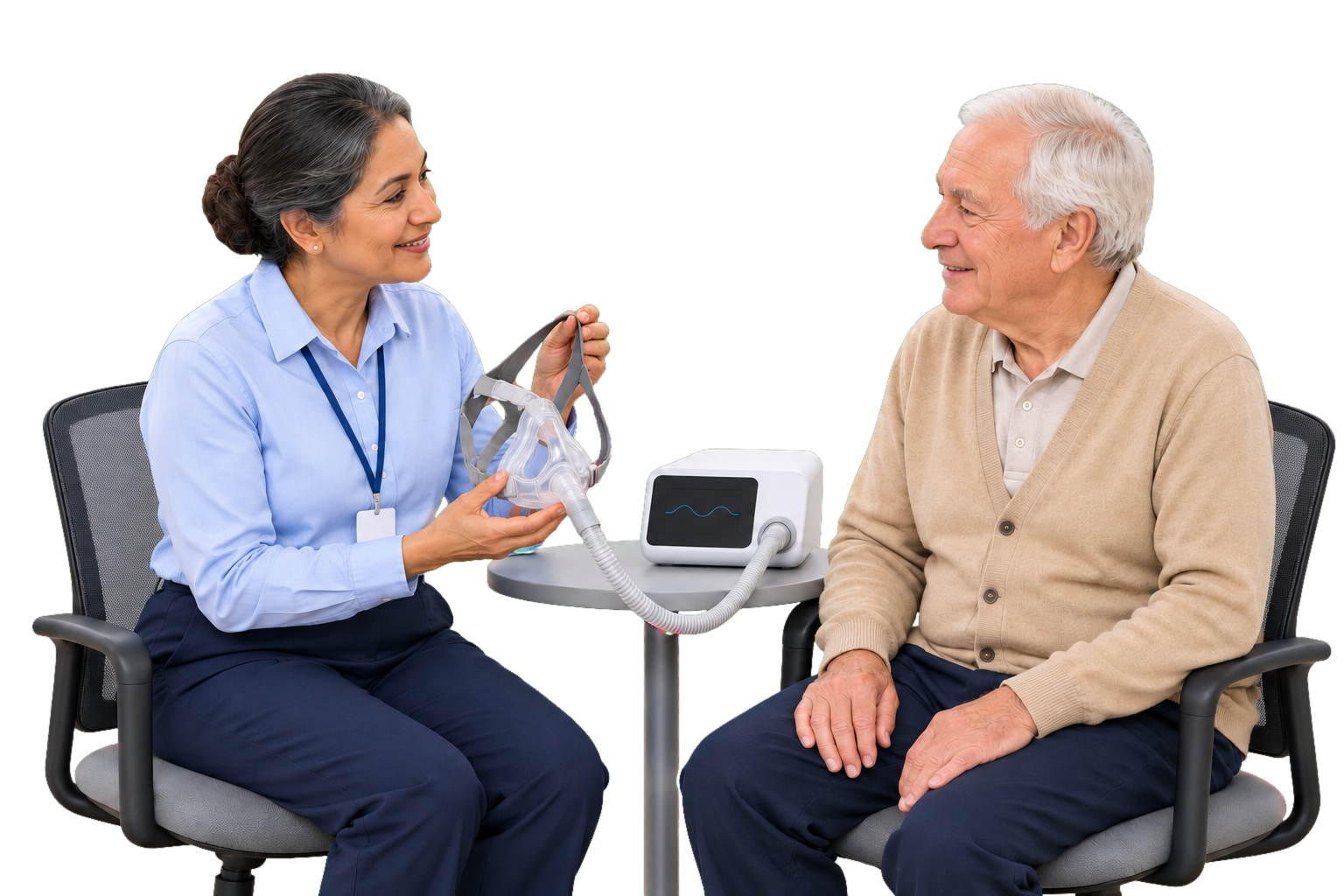
A bilevel machine sends air along a tube to a mask over your nose, or your nose and mouth, much as a CPAP machine does. CPAP keeps the pressure steady, while a bilevel machine switches between two levels: higher when you breathe in and lower when you breathe out.
The extra pressure on each breath in makes the breath bigger, so more air moves in and out of the lungs. This helps when breathing becomes too shallow during sleep (hypoventilation), for example when weak breathing muscles cannot move enough air. Bilevel therapy is a type of non-invasive ventilation (NIV), which supports breathing through a mask.
Shallow breathing in sleep can let carbon dioxide build up in the blood, which can cause morning headaches or confusion. Bilevel therapy supports your breathing but may not take it over completely, and the condition behind the breathing problem still needs its own care.
Call triple zero (000) immediately if you are short of breath and any of these apply: you cannot speak in full sentences, you have pain in your chest, arm, or jaw, your skin is pale and sweaty, your lips are blue, or you feel drowsy or confused.
Do not wait for a routine appointment or drive yourself to hospital.
The pressures and other settings are chosen for you. They can be worked out during an overnight sleep study, or during the day while you are awake. When a titration study is needed, it takes place in a hospital sleep laboratory, and the sleep physician can refer you.
During an overnight titration study, you sleep wearing the mask while a sleep scientist adjusts the settings. The recording includes your breathing, your oxygen and carbon dioxide levels, and any air leaking from the mask.
A mask that fits well, without leaks, helps the machine support your breathing, because even small leaks lower the pressure. The mask may be a nasal one, or one that covers the mouth as well.
Bilevel therapy can be started without a hospital stay, and the machine sits beside your bed at home so you can use it when you sleep.
Bilevel therapy at home is often used for weakness of the breathing muscles, for example from some nerve and muscle conditions. Another usual reason is obesity hypoventilation syndrome, in which a high body weight makes breathing too shallow. A curved spine or another problem with the chest wall, or a long-term lung condition such as COPD, can also lead to shallow breathing in sleep.
To look for shallow breathing in sleep, an in-lab sleep study is usually needed, because it can measure carbon dioxide through the night as well as oxygen. The study takes place in a hospital sleep laboratory, and the sleep physician can refer you.
Bilevel therapy may also be used for obstructive sleep apnoea when the pressure needed to keep the airway open is higher than a CPAP machine can give.
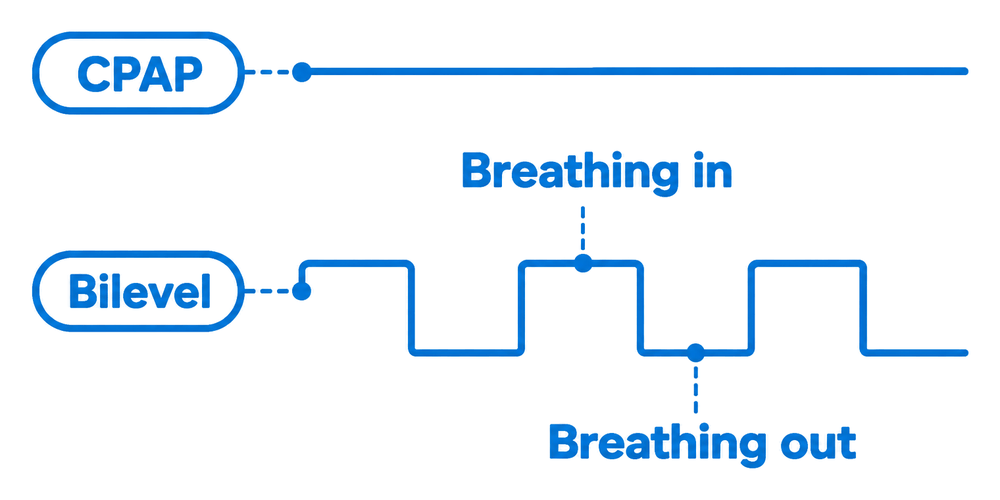
CPAP blows air at one steady pressure, or at a pressure that adjusts itself through the night, to stop the throat closing in obstructive sleep apnoea.
As well as keeping the airway open, a bilevel machine helps move air in and out of the lungs with each breath. Some machines can also adjust their pressures through the night to keep your breathing at a set level.
A related machine, adaptive servo ventilation (ASV), is used for some types of central sleep apnoea, but it is not suitable for some people with heart failure.
Where heart failure or another condition plays a part, its own treatment continues alongside any breathing machine, so please keep taking your medications unless your doctor changes them. If you have a heart condition, the sleep physician will take it into account when discussing these machines.
Getting used to bilevel therapy can be hard for some people. Please tell the sleep physician, because the settings or the mask may need changing, and a sleep study with the machine is sometimes suggested.
Please use the machine whenever you sleep, as advised. Clean the mask, straps, and tubing each week, and look after the humidifier as the manufacturer's instructions describe. Please report any unusual noise or change in the machine to the supplier straight away.
Air can leak around the mask, and the airflow can dry your nose and throat, which a humidifier may ease. Sometimes the machine's timing does not match your own breathing. This can be hard to notice, and a sleep study with the machine can show it.
The sleep physician can review how your treatment is going at a later consultation. This includes your sleep, how you feel during the day, and any trouble with the mask or machine. If your symptoms do not improve, a sleep study with the machine may be suggested to check the settings.
Please see your doctor promptly if morning headaches, drowsiness, confusion, or breathlessness become worse, rather than waiting for the next check. Call triple zero (000) if you have severe difficulty breathing.
You will need a valid referral from your GP or specialist for a sleep consultation. The sleep physician will ask about your sleep and breathing, review your medical history and medications, and may recommend further tests. They can also discuss whether bilevel therapy or another treatment may suit you and, at a later consultation, how your treatment is going.
Fees are listed on each clinic's page, and the clinic will confirm them before your visit.
The consultation takes up to 30 minutes and needs no preparation. Please arrive 10 to 15 minutes early to complete the forms. After your visit, the sleep physician will send a letter to your referring doctor.
Sleepscope physicians see patients at clinics in Victoria and Queensland. If you have a referral, our team can confirm the location and appointment details.
View clinic locationsYes, with a valid referral from your GP or specialist. A Sleepscope sleep physician can assess your sleep and breathing and discuss whether bilevel therapy or another treatment may suit you. They can also review how your treatment is going at a later consultation. If a titration study is needed, the sleep physician can refer you to a hospital sleep laboratory.
Please talk to your sleep physician. Problems with CPAP, such as a leaking mask or a dry nose, can often be eased with changes to the mask or equipment. Bilevel therapy is used mainly when breathing needs extra support, or when sleep apnoea needs more pressure than a CPAP machine can give.
Please keep the contact details of the service that set up your machine, and call them if it breaks down. Call triple zero (000) if you have severe difficulty breathing.