

CPAP Alternatives
Besides CPAP, treatments for obstructive sleep apnoea include an oral appliance, sleeping off your back, weight loss, and surgery. Each suits only some people, and a Sleepscope sleep physician can discuss your options.
In obstructive sleep apnoea, the throat narrows or closes many times during sleep. CPAP holds it open with air pressure through a mask, but some people cannot keep using it, and others want to know what else may help.
The other treatments work in different ways. An oral appliance holds the lower jaw forward, and positional therapy keeps you off your back. Losing weight or treating a blocked nose can reduce what narrows the airway, and surgery changes the airway itself. Some people combine two or more treatments.
What narrows the airway differs between people, and so does the treatment that helps. The choice rests on the severity of your sleep apnoea, where your airway narrows, your general health, and what you can keep using.
Call triple zero (000) immediately if you are short of breath and any of these apply: you cannot speak in full sentences, you have pain in your chest, arm, or jaw, your skin is pale and sweaty, your lips are blue, or you feel drowsy or confused.
Do not wait for a routine appointment or drive yourself to hospital.
The sleep physician considers your sleep study results and symptoms, the shape of your nose, mouth, and throat, and what you feel able to keep using.
Treatment is not always needed when sleep apnoea is mild and causes few symptoms. Changes such as weight loss, less alcohol in the evening, or a change of sleep position may be enough, and an oral appliance is another option.
The sleep physician can look at what makes CPAP hard for you and whether it can be fixed. If it cannot, an oral appliance or surgery may be considered, depending on your sleep apnoea and your airway. When sleep apnoea needs more pressure than a CPAP machine can give, bilevel therapy may be an option.
Large tonsils, a blocked nose, or the shape of the jaw can narrow the airway. An opinion from a surgeon, usually an ear, nose and throat (ENT) surgeon, may then help, and the sleep physician can refer you.
Some people try CPAP and cannot keep using it. Others have mild sleep apnoea with few symptoms, or breathing pauses that happen mainly when they lie on their back. An alternative may also be considered when large tonsils or a blocked nose are part of the problem.
If CPAP is hard to use, please talk to your sleep physician before you stop, because the breathing pauses return soon afterwards. Problems such as a leaking mask or a dry nose can often be eased with a different mask, a humidifier, or an adjustment to the machine.
Some changes can help whichever treatment you use: weight loss if you carry extra weight, drinking less alcohol, particularly in the evening, stopping smoking, and regular exercise. Sleeping tablets can also make sleep apnoea worse. Please talk to your doctor before changing a prescribed medication.
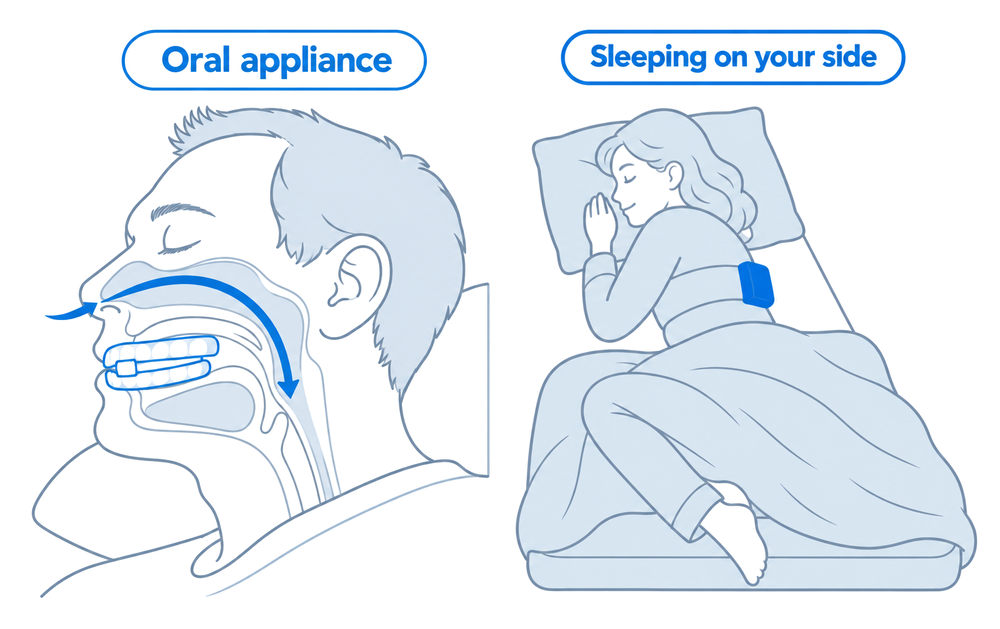
An oral appliance, made and fitted by a dentist, holds the lower jaw forward during sleep, which makes the airway wider. It can help with snoring, and with sleep apnoea that is mild or moderate. Some people with more severe sleep apnoea who cannot use CPAP may also be able to use one.
Positional therapy keeps you off your back while you sleep, because breathing pauses are often worse in that position. It can be done with a tennis ball fixed to the back of a sleep top, or with a device made for the purpose. It may suit people whose sleep apnoea happens mainly when they lie on their back, though some people struggle to keep using it.
If you are overweight, losing weight often reduces snoring and breathing pauses. It can also improve how well other treatments work, for example by lowering the pressure CPAP needs. It does not always make sleep apnoea go away. A blocked nose can come from allergies, sinus problems, or a bent septum (the wall between the nostrils). Nasal sprays or sometimes surgery can treat it, and this can also make CPAP easier to use.
Surgery on the nose, throat, tongue, or jaw may be considered when a blockage in one part of the airway is the problem, and adults usually try other treatments first. For some people who cannot use CPAP, an operation can place an implant that stimulates the nerve to the tongue during sleep (hypoglossal nerve stimulation).
A home based sleep study or an in-lab sleep study shows how severe your sleep apnoea is. The report can also show whether the pauses are worse on your back. An in-lab study takes place in a hospital sleep laboratory, and the sleep physician can refer you. After a new treatment such as an oral appliance or surgery, another sleep study may be needed to check how well it is working.
The sleep physician will look at your nose, mouth, and throat. An ENT surgeon may look inside the airway with a thin, flexible camera passed through the nose to see where it narrows. Before making an oral appliance, a dentist checks your teeth and jaw.
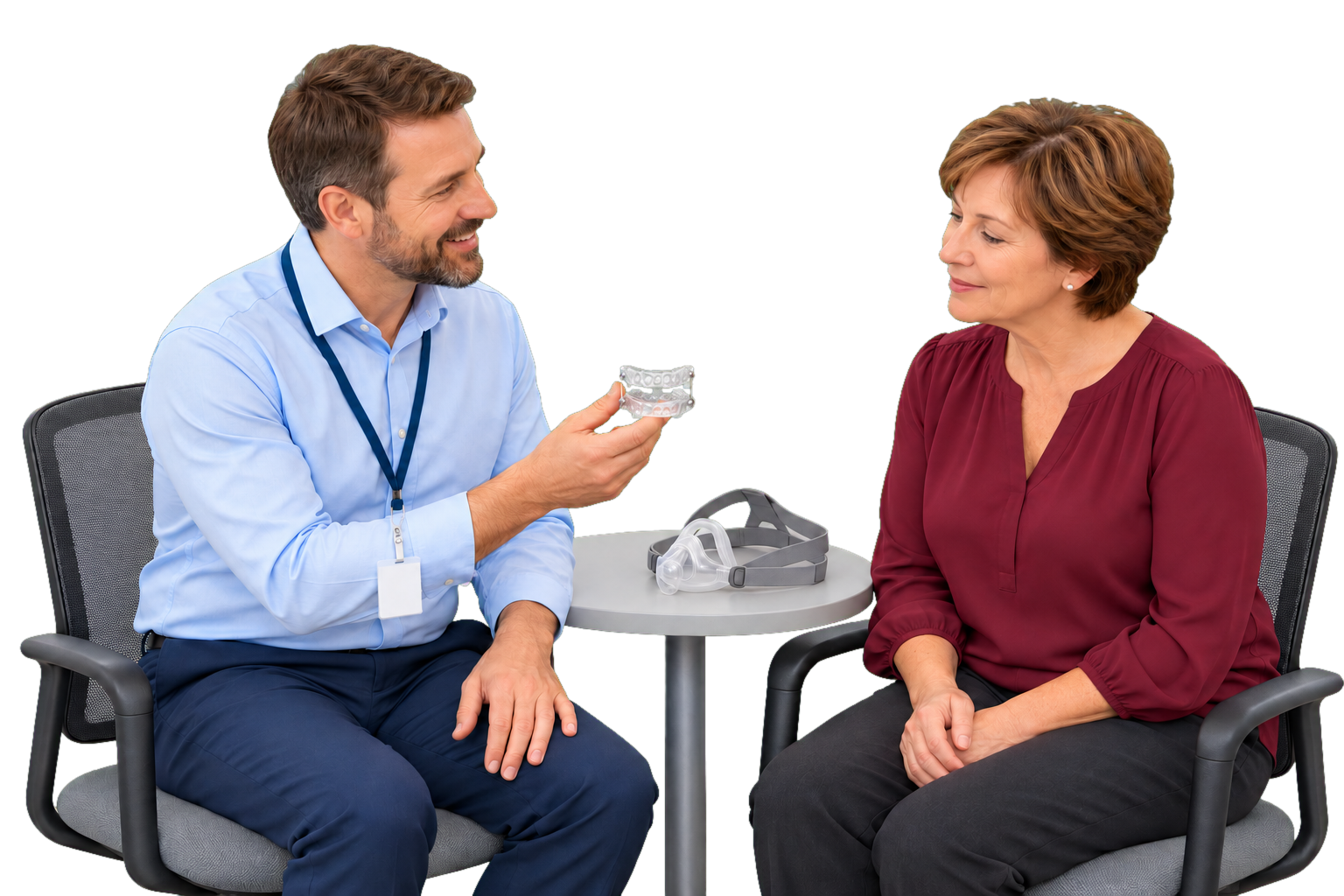
You will need a valid referral from your GP or specialist for a sleep consultation. The sleep physician can discuss which treatments may suit you. When needed, they can refer you to a dentist for an oral appliance, or to an ENT surgeon for an opinion on surgery. Oral appliances are made by dentists, and surgery takes place in hospital.
Fees are listed on each clinic's page, and the clinic will confirm them before your visit.
The consultation takes up to 30 minutes and needs no preparation. Please arrive 10 to 15 minutes early to complete the forms. After your visit, the sleep physician will send a letter to your referring doctor.
Sleepscope physicians see patients at clinics in Victoria and Queensland. If you have a referral, our team can confirm the location and appointment details.
View clinic locationsYes, with a valid referral from your GP or specialist. A Sleepscope sleep physician can discuss which treatments may suit you, and refer you to a dentist or an ENT surgeon when needed.
Please talk to your sleep physician first. Sleep apnoea comes back soon after CPAP is stopped, so it is worth discussing what may take its place before you stop. A sleep study may be needed later to check that a new treatment is working.
Sometimes. After a large weight loss, some people need less treatment, or none at all, but for many people sleep apnoea remains. Please keep using your treatment until your sleep physician advises otherwise.
Please see your GP or sleep physician if your snoring or daytime sleepiness comes back or becomes worse, or if a treatment is not helping or is hard to use. Call triple zero (000) if you have severe difficulty breathing. Do not wait for a routine appointment.