

Breathlessness Assessment
Ongoing shortness of breath can come from the lungs, the heart, or other causes. At Sleepscope, a respiratory physician can look at your breathing and test results to help find the cause.

Breathlessness (dyspnoea) is the feeling that you cannot get enough air into your lungs. It is normal after hard exercise, but breathlessness that comes on with less effort than before should be checked by a doctor.
Lung conditions, heart conditions, anaemia, anxiety, being less fit, and carrying extra weight can all cause breathlessness. Your doctor will weigh the pattern of your symptoms alongside an examination and test results to look for the cause.
The breathlessness assessment is for people whose GP or specialist has checked their symptoms and recommended an appointment with a respiratory physician. If your breathing suddenly becomes worse, please call triple zero (000) rather than waiting for the appointment.
Call triple zero (000) immediately if you are short of breath and any of these apply: you cannot speak in full sentences, you have pain in your chest, arm, or jaw, your skin is pale and sweaty, your lips are blue, or you feel drowsy or confused.
Do not wait for a routine appointment or drive yourself to hospital.
Your description will help your doctor decide which checks or tests you need.
Please tell your doctor how long you have been breathless, whether it is getting worse, and what brings it on: walking on flat ground, climbing stairs, lying down, or resting, for example. Mention whether it wakes you at night.
Describe any cough, phlegm, wheezing, chest pain, swollen ankles, palpitations (a racing or pounding heartbeat), or dizziness that comes with it, and whether you have had a fever or a recent chest infection.
Mention any heart or lung condition, smoking or vaping now or in the past, dust or fumes at work, and every medication you take, including inhalers.
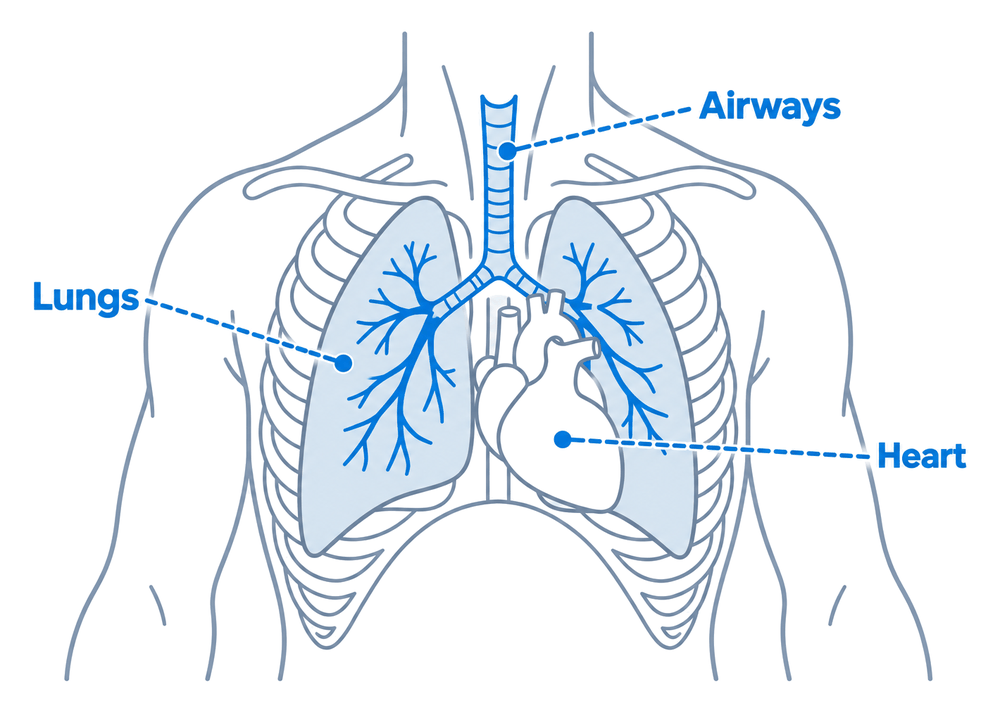
Asthma and chronic obstructive pulmonary disease (COPD) narrow the airways, which makes breathing harder. Bronchiectasis, in which damaged airways collect mucus, can cause breathlessness with an ongoing wet cough. In pulmonary fibrosis, the lung tissue becomes scarred and stiff. Chest infections, including COVID-19, can also leave you breathless for a time.
Breathlessness that comes on suddenly should be checked straight away, because some causes, such as a blood clot in the lungs (pulmonary embolism), need treatment quickly.
Heart conditions, such as heart failure, can cause breathlessness with exertion or when lying down, sometimes with swollen ankles. In anaemia, the blood has fewer red blood cells to carry oxygen around the body, which can also leave you short of breath.
When fitness is low, effort leaves you more breathless, and carrying extra weight or being pregnant can add to it. Anxiety or panic can bring on breathlessness, and feeling breathless can itself be frightening.
Treatment depends on the cause. Inhaled medications can open the airways in asthma and COPD, and conditions such as heart failure or anaemia are treated in their own way. The respiratory physician will explain the options based on your symptoms and test results.
Some techniques can make breathlessness easier to manage. They include slowing down, breathing out slowly, leaning forward with your arms resting on your thighs or a table, and holding a handheld fan so it blows cool air across your face. A pulmonary rehabilitation program teaches exercise and breathing skills to people with lung conditions. Programs run outside Sleepscope, and your GP or respiratory physician can refer you.
Staying active, keeping to a healthy weight, and quitting smoking can also help. Please talk to your doctor before starting a new exercise plan, and tell them if breathlessness becomes worse or comes on with less effort than before.
The respiratory physician will choose tests based on the likely cause. Your oxygen level can be measured with a small clip on your finger.
Spirometry measures how much air you can breathe out and how fast. A lung function test adds a gas transfer test, which shows how well oxygen moves from the lungs into the blood. Both are available at some Sleepscope clinics, and some inhalers need to be stopped beforehand, as each test's page explains.
A chest X-ray or CT scan takes pictures of the lungs. Sleepscope offers both through Scope Radiology, which is at M-City Clayton, in Melbourne's south-east. Blood tests can check for anaemia and other causes. The respiratory physician can refer you for them, and a separate pathology service carries them out.
If a heart cause is suspected, the physician may refer you for an electrocardiogram (ECG), which records the heart's electrical activity, or an echocardiogram, an ultrasound scan of the heart, at Heartscope, a cardiology service. Each test answers a different question, so not everyone with breathlessness needs all of them.
You will need a valid referral from your GP or specialist for a respiratory consultation. The respiratory physician will ask about your breathing, including when the problem started and how it affects daily life, and review your medical history and medications.
Fees are listed on each clinic's page, and the clinic will confirm them before your visit.
The consultation takes up to 30 minutes and needs no preparation. If spirometry or a lung function test is booked as well, some inhalers need to be stopped beforehand, as set out on that test's page.
Please arrive 10 to 15 minutes early to complete the forms. After your visit, the respiratory physician will send a letter to your referring doctor. Tests at other services need separate appointments.
Sleepscope physicians see patients at clinics in Victoria and Queensland. If you have a referral, our team can confirm the location and appointment details.
View clinic locationsYes, with a valid referral from your GP or specialist. For sudden or severe breathlessness, please call triple zero (000). Sleepscope offers chest X-rays and CT scans through Scope Radiology. Other tests, such as blood tests and heart tests, may be done by another provider.
It can. Before putting breathlessness down to anxiety, please let your doctor check for other causes, such as a lung or heart condition.
Please tell your doctor if breathlessness continues or changes. They can explain what your results do and do not show, and whether more tests would help.
Please talk to your doctor before starting or changing an exercise plan. Staying active is part of managing many lung conditions, and a pulmonary rehabilitation program can teach exercise at a level that suits you.