

Chronic Cough Assessment
In adults, a cough that lasts longer than eight weeks is called a chronic cough, and it can have several causes. At Sleepscope, a respiratory physician can help find the cause and discuss treatment.

In adults, a cough counts as chronic once it has lasted longer than eight weeks. Coughing is a protective reflex that clears mucus and anything breathed in from the airways, but an ongoing cough can disturb sleep and affect daily life.
A cough can be dry or bring up phlegm (sputum). Sometimes the reflex that triggers coughing becomes oversensitive, which can keep a cough going.
The chronic cough assessment is for people whose GP or specialist has checked the cough and recommended an appointment with a respiratory physician. If your symptoms suddenly become worse, please call triple zero (000) rather than waiting for the appointment.
Call triple zero (000) immediately if you are short of breath and any of these apply: you cannot speak in full sentences, you have pain in your chest, arm, or jaw, your skin is pale and sweaty, your lips are blue, or you feel drowsy or confused. Call triple zero (000) as well if you cough up a lot of blood.
Do not wait for a routine appointment or drive yourself to hospital.
Your description will help your doctor decide which checks or tests you need.
Please tell your doctor when the cough started, whether it followed a cold or chest infection, and whether it is dry or brings up phlegm. Describe the colour of any phlegm, and say whether anything seems to bring the cough on, such as lying down, eating, or talking.
Mention any breathlessness, wheezing, heartburn, a blocked or runny nose, hoarseness, or a feeling of something stuck in your throat, as well as any weight loss or fever.
Mention smoking or vaping now or in the past, dust or fumes at work, any lung condition, and every medication you take, including blood pressure medications and inhalers.
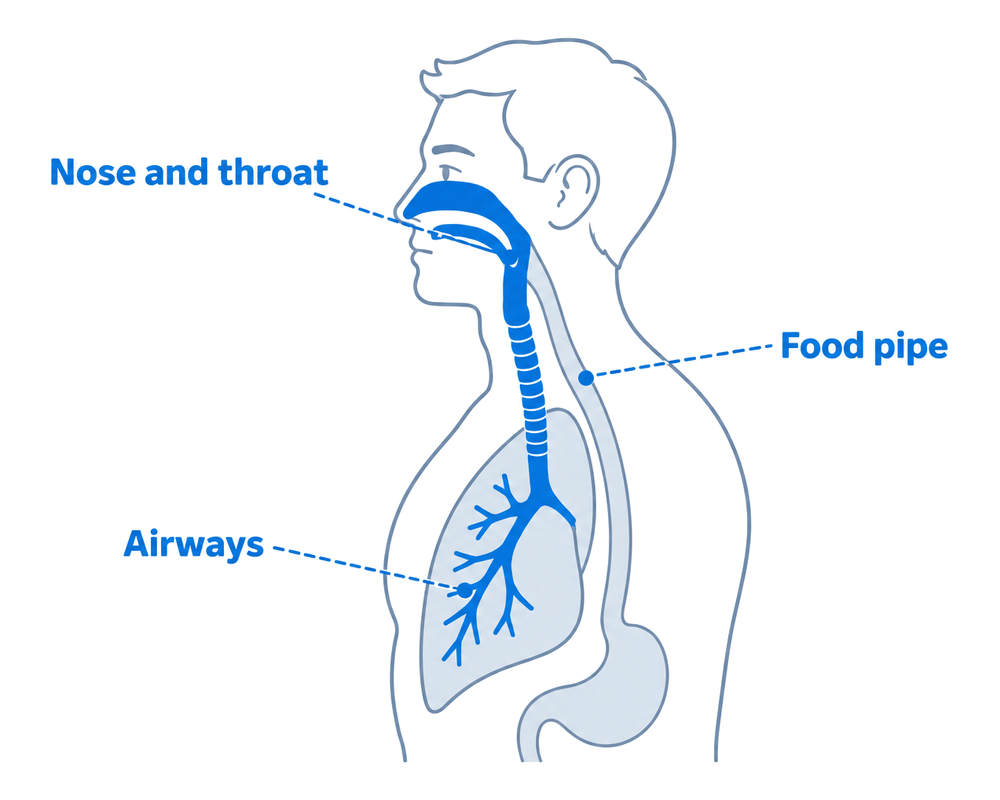
Asthma can cause a persistent cough, which may be called cough-variant asthma. A type of airway inflammation called eosinophilic bronchitis is another cause, and a cough can linger for weeks after a viral infection.
Long-term lung conditions, such as COPD and bronchiectasis, often cause a cough that brings up phlegm, and smoking or vaping makes a cough worse. Less often, a chronic cough comes from an infection such as tuberculosis or from a lung condition that needs prompt treatment, which is one reason a cough that does not settle should be checked.
Mucus from the back of the nose or the sinuses dripping down the throat (postnasal drip, also called upper airway cough syndrome) can cause a cough. So can an oversensitive voice box (laryngeal hypersensitivity).
Stomach acid rising into the food pipe (reflux, or GORD) can irritate the throat and airways and cause a cough. Some blood pressure medications (ACE inhibitors) can also cause a cough. Please do not stop a prescribed medication yourself; your doctor can advise whether a different one would suit you. Obstructive sleep apnoea and heart failure can cause a chronic cough as well.
Treatment is directed at the cause, for example inhaled medications for asthma or COPD, or treatment for reflux. Finding what works can take time, and the plan may change as treatment goes on.
A speech pathologist can teach techniques to control the urge to cough, and your doctor may consider medications that act on the nerves involved in coughing (neuromodulators). Your GP or respiratory physician can refer you to a speech pathologist.
Quitting smoking or vaping, and avoiding other people's smoke, helps the airways. Please tell your doctor if the cough changes, or if new symptoms appear.
For adults with a chronic cough, the first tests are usually a chest X-ray and spirometry before and after a reliever medication.
Spirometry measures how much air you can breathe out and how fast, which helps diagnose asthma and COPD. An exhaled nitric oxide (FeNO) test measures nitric oxide in your breath, which shows inflammation in the airways and can support a diagnosis of asthma. Both are available at some Sleepscope clinics, and some inhalers need to be stopped before spirometry, as its page explains.
A chest X-ray or CT scan takes pictures of the lungs. Sleepscope offers both through Scope Radiology, which is at M-City Clayton, in Melbourne's south-east. A sample of phlegm may be tested for infection. The respiratory physician can refer you for this, and a separate pathology service carries it out.
If you have coughed up blood or lost weight, or if the cause is still unclear, the respiratory physician may recommend a CT scan or a bronchoscopy. During a bronchoscopy, a doctor examines the airways from the inside. It takes place in hospital, and a Sleepscope respiratory physician can assess you and refer you. Depending on the likely cause, your doctor may also suggest seeing an ear, nose, and throat (ENT) specialist or a gastroenterologist. Not everyone needs all of these tests.
You will need a valid referral from your GP or specialist for a respiratory consultation. The respiratory physician will ask about your cough, including when it started and how it affects daily life, and review your medical history and medications.
Fees are listed on each clinic's page, and the clinic will confirm them before your visit.
The consultation takes up to 30 minutes and needs no preparation. If spirometry or a lung function test is booked as well, some inhalers need to be stopped beforehand, as set out on that test's page.
Please arrive 10 to 15 minutes early to complete the forms. After your visit, the respiratory physician will send a letter to your referring doctor. Tests at other services need separate appointments.
Sleepscope physicians see patients at clinics in Victoria and Queensland. If you have a referral, our team can confirm the location and appointment details.
View clinic locationsYes, with a valid referral from your GP or specialist. Sleepscope offers chest X-rays and CT scans through Scope Radiology. Other tests, such as tests on blood or phlegm, may be done by another provider, and a bronchoscopy takes place in hospital.
It can. After a viral infection, a cough can continue for weeks. Please see your doctor about any cough that has lasted longer than three weeks. Go sooner if you feel short of breath, have chest pain, or cough up blood.
Not usually on its own. Over-the-counter cough medications and antibiotics are unlikely to settle a chronic cough, and cough medications can have side effects. Please ask your doctor or pharmacist before using them.
Please tell your doctor if the cough continues or changes. They can explain what your results do and do not show, and whether further tests or a different treatment would help.