Our Services
In-lab Sleep Study

In-lab Sleep Study

An in-lab sleep study records your sleep, breathing, and movements overnight while a sleep scientist monitors the recording. It helps diagnose sleep apnoea and other sleep disorders. The study takes place in a hospital sleep laboratory.

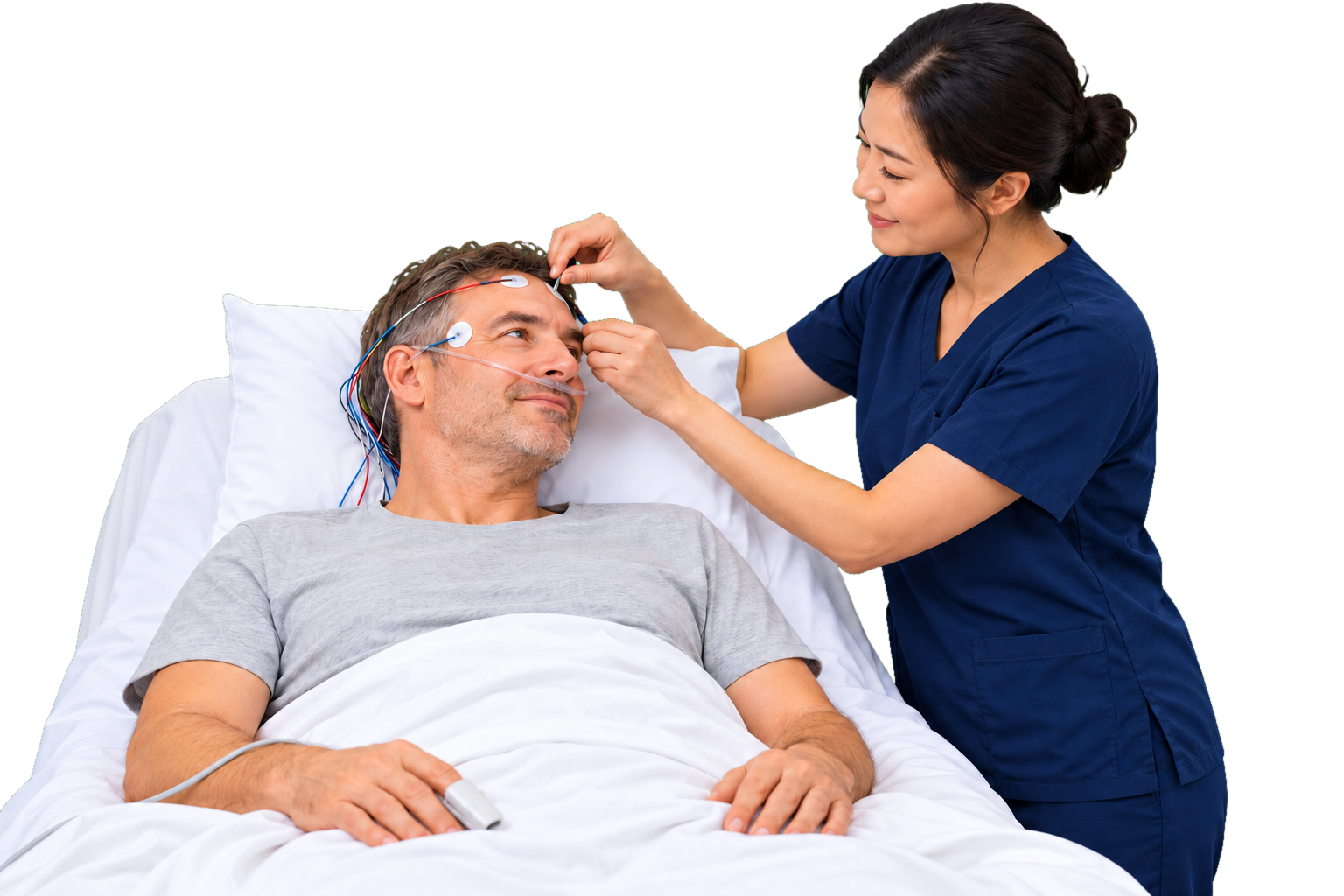
Illustrative overnight sleep study in a sleep laboratory.

What does an in-lab sleep study show?

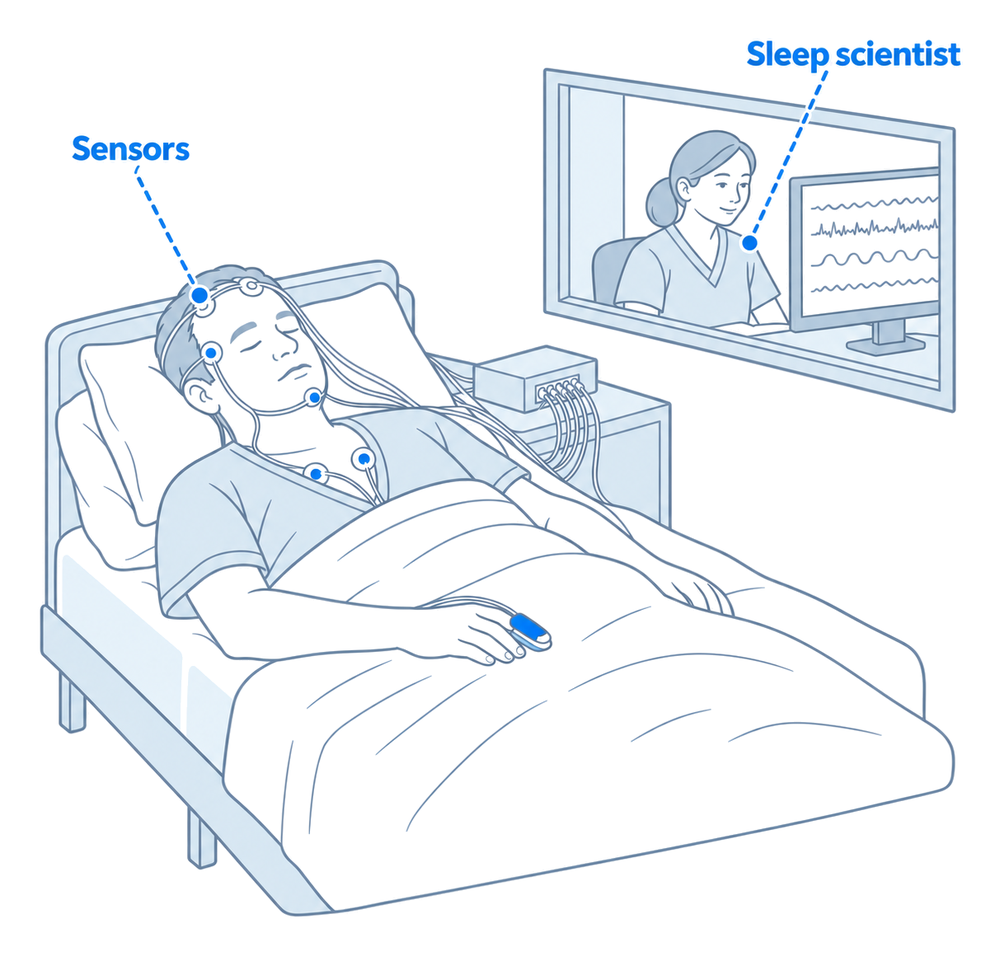
A man asleep with sensors in a sleep laboratory while a sleep scientist watches from a nearby room.
The sleep scientist watches the recording from a nearby room.

An in-lab sleep study (polysomnography) records a night of sleep in a hospital sleep laboratory. Small sensors measure your brain waves, eye movements, muscle activity, heart rhythm, breathing, oxygen level, body position, and snoring, and video may be recorded as well.

A sleep scientist watches the signals through the night from a nearby room to make sure they are recorded well. The results show how long and how deeply you sleep, and how your breathing, heart, and movements change during sleep.

Need urgent care?

Call triple zero (000) immediately if you are short of breath and any of these apply: you cannot speak in full sentences, you have pain in your chest, arm, or jaw, your skin is pale and sweaty, your lips are blue, or you feel drowsy or confused.

Do not wait for a routine appointment or drive yourself to hospital.

What happens on the night?

You arrive at the sleep laboratory in the evening and have a bedroom to yourself. A sleep scientist attaches the sensors to your head, face, chest, and legs with sticky patches or a little cream, and a clip goes on your finger. The sensors are taken off in the morning, and then you can leave.

Keeping comfortable

Toilets and showers are close by, and a call system links your room to the monitoring room, so you can call staff during the night.

Please tell the sleep scientist if you feel unwell or uncomfortable, or if a sensor bothers you. Your skin may look slightly red where the patches or cream were, and this fades quickly.

Why might your doctor recommend it?

An in-lab study can help diagnose obstructive and central sleep apnoea and movements during sleep. It can also show unusual behaviour in sleep, such as sleepwalking, and look for conditions that cause severe sleepiness, such as narcolepsy. Before a multiple sleep latency test (MSLT), the overnight study checks that you slept enough and looks for other sleep disorders.

It is also used when a home study is not suitable or has not given a clear answer. This includes people with some heart, lung, or nerve and muscle conditions, people who take strong pain medications (opioids) regularly, and people who have had a stroke.

How is it different from a home study?

In the laboratory or at home

In the laboratory, a sleep scientist monitors the recording all night, and video can show what happens during sleep. A home based sleep study is fitted at a Sleepscope clinic, and you then sleep in your own bed and follow your usual routine.

Some people find it harder to sleep in an unfamiliar place, while others need the extra monitoring of a laboratory. The sleep physician will advise which study suits your symptoms and health.

Studies with treatment

Some in-lab studies are done with treatment in place. In a CPAP titration study, you sleep wearing CPAP while the sleep scientist gradually adjusts the air pressure until it is just enough to keep your airway open.

People with uncomplicated sleep apnoea can start CPAP at home instead, while a laboratory study is recommended for some people with heart or lung conditions or with central sleep apnoea. A study can also check how well another treatment, such as an oral appliance, is working.

Preparing for the study and getting your results

Before the night

Please follow the instructions the sleep laboratory gives you, including what to bring for the night. Unless you are told otherwise, keep to your normal routine during the day. Please do not stop or change a medication without your doctor's advice.

Nail polish can affect the oxygen reading from the sensor on your finger, so the laboratory may ask you to remove it.

The laboratory will tell you what time to arrive and when you can expect to leave in the morning.

After the study

If you feel sleepy in the morning, please do not drive, and ask someone to take you home.

How the results guide care

After the night, the recording is analysed in detail and a report goes to the doctor who referred you for the study, who can go through the results with you.

The findings help decide whether you need treatment and which kind may suit you, such as CPAP or an oral appliance for sleep apnoea. A study does not always explain everything on its own, so the sleep physician considers it together with your symptoms and any earlier results.

If you have been referred to Sleepscope

Your GP or specialist can refer you to a Sleepscope sleep physician to discuss your sleep symptoms or test results. If an in-lab study would help, the sleep physician can refer you to a hospital sleep laboratory, which will give you its own instructions for the night.

Fees are listed on each clinic's page, and the clinic will confirm them before your visit.

The consultation takes up to 30 minutes and needs no preparation. Please arrive 10 to 15 minutes early to complete the forms. After your visit, the sleep physician will send a letter to your referring doctor.

What to bring

  • Your GP or specialist referral and any previous sleep study reports.
  • Your Medicare card.
  • A list of your medications and supplements, including doses.
  • Notes on how you sleep, and questions for the sleep physician.

Where you can be seen

Sleepscope physicians see patients at clinics in Victoria and Queensland. If you have a referral, our team can confirm the location and appointment details.

View clinic locations

Common questions

Does Sleepscope perform in-lab sleep studies?

No. In-lab sleep studies take place in a hospital sleep laboratory. Sleepscope sleep physicians may be able to see patients with a valid referral from their GP or specialist, and can refer you for the study.

Why have an in-lab study if I have had a home study?

A home study may not have given a clear answer. Your symptoms or health may also need the closer monitoring of a laboratory, for example when narcolepsy or a parasomnia is suspected. The sleep physician will explain why it has been suggested.

Is an in-lab sleep study the same as an MSLT?

No. An in-lab sleep study records a night of sleep. The MSLT is a daytime test of how quickly you fall asleep during a series of naps, and it is done the day after an overnight study.

What if I cannot sleep in the laboratory?

Sleeping somewhere unfamiliar can be harder for some people. Please tell the sleep scientist if you are struggling, and let the sleep physician know if the night was very different from usual. If you slept very little, they will advise whether another study is needed.