

Bronchiectasis
In bronchiectasis, damaged airways do not clear mucus well, which can lead to a wet cough and repeated chest infections. At Sleepscope, a respiratory physician can investigate your symptoms or help manage an existing diagnosis.
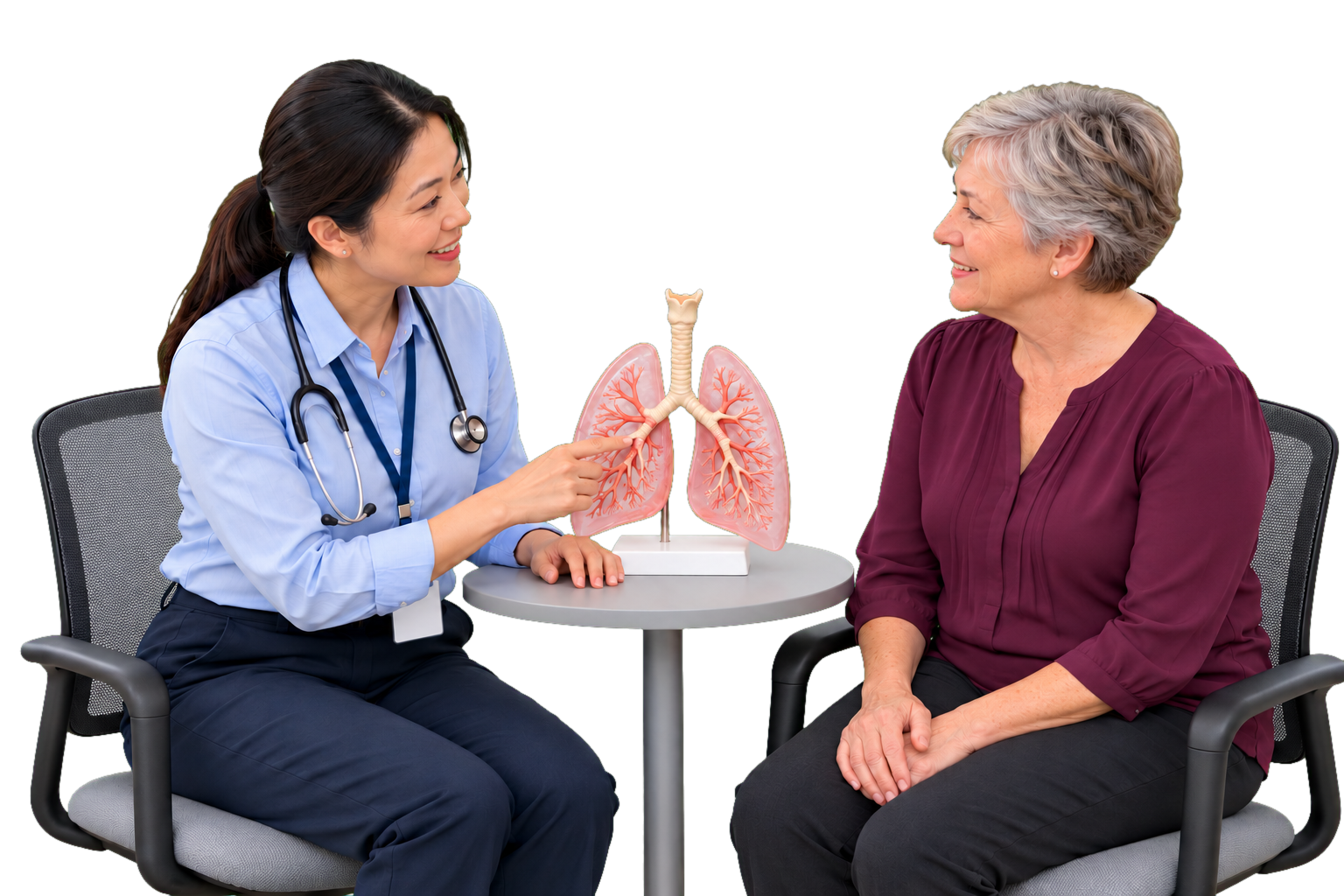
In bronchiectasis, some of the airways in the lungs have been damaged and have become wider than normal. Widened airways do not clear mucus well, so it can build up and lead to repeated chest infections. The damage may be limited to one part of a lung, or it may involve both lungs.
In adults, bronchiectasis is a long-term condition, and the widened airways do not return to normal. Treatment aims to ease symptoms, cut down on infections, and protect the lungs from more damage. During a flare-up (exacerbation), symptoms are much worse than they normally are. Flare-ups need early treatment, so please see your doctor when one starts.
Call triple zero (000) immediately if you are short of breath and any of these apply: you cannot speak in full sentences, you have pain in your chest, arm, or jaw, your skin is pale and sweaty, your lips are blue, or you feel drowsy or confused. Call triple zero (000) as well if you cough up a lot of blood.
Do not wait for a routine appointment or drive yourself to hospital.
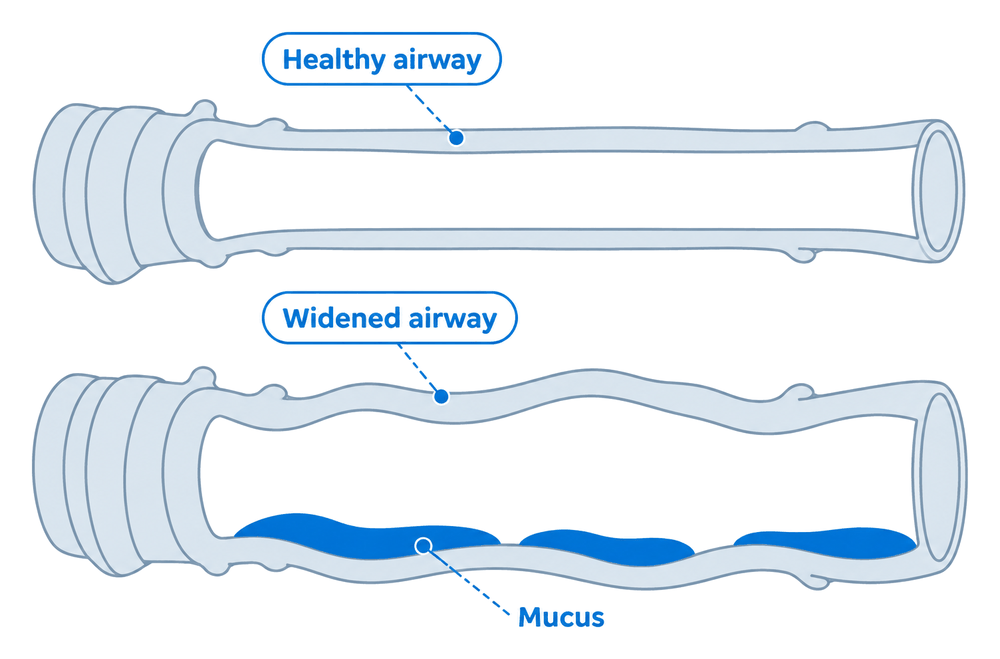
The bronchi are the tubes that carry air into the lungs, where they branch into smaller and smaller airways. In healthy airways, dust and germs are caught by mucus and tiny hairs, which keeps the lungs clean. In bronchiectasis this cleaning works less well. Three linked changes are involved, and each makes the next more likely.
Inflammation or infection has damaged the airway walls, leaving them wider and less elastic. A CT scan shows which airways are affected and how much of the lung is involved.
Damaged airways make extra mucus and are less able to move it out, so it collects in the widened sections. Mucus that you cough up is called sputum, and the main symptom is an ongoing wet cough.
Mucus that stays in the airways can lead to repeated chest infections, and an infection can add to the damage. This is why clearing mucus every day and treating flare-ups early are both part of care.
Bronchiectasis can follow a serious lung infection, especially one in childhood. Pneumonia, whooping cough, and tuberculosis are examples. Other causes include cystic fibrosis, COPD or asthma, immune system problems, and inflammatory diseases such as rheumatoid arthritis. Often no cause is found, and it can occur at any age.
People often first notice symptoms when they are older. They include:
These symptoms do not always mean bronchiectasis. Your doctor will ask about them, examine you, and look at test results to work out the cause. Please see a doctor as soon as possible if you cough up blood, even a small amount.
Moving mucus out of the chest each day lowers the chance of flare-ups. A respiratory physiotherapist teaches the techniques, which may include breathing exercises and devices, and reviews them over time. Physiotherapy is not provided at Sleepscope, and your GP or respiratory physician can refer you to a physiotherapist.
Antibiotics are the usual treatment for infections during a flare-up, and people who have frequent flare-ups may be prescribed a long-term antibiotic to reduce them. Salt water (saline) breathed in as a mist is sometimes used to help clear mucus. Inhalers used for asthma or COPD are prescribed case by case, for example when someone also has asthma. Please take your medications as your doctor directs, and do not stop them yourself.
A written bronchiectasis action plan sets out your usual symptoms and what to do when they change. You and your doctor will make the plan together and review it regularly.
Everyone with bronchiectasis is advised to exercise regularly. Pulmonary rehabilitation is a program of exercise and education, usually six to eight weeks long, run by hospital and community services outside Sleepscope. Your GP or respiratory physician can refer you.
Keeping up to date with influenza, pneumococcal, and COVID-19 vaccinations can help prevent flare-ups. So can quitting smoking and treating reflux, sinus problems, or hay fever. Surgery is rarely needed. If it is, a badly damaged part of the lung is removed in hospital.
Diagnosis brings together your symptoms, your history of chest infections, an examination, and a scan of the lungs. Bronchiectasis shares symptoms with other lung conditions and can occur alongside asthma or COPD, so symptoms alone cannot confirm it. Earlier scans and reports help show whether anything has changed.
A high-resolution CT scan takes detailed pictures of the lungs and airways and is the scan used to confirm bronchiectasis. A chest X-ray may be taken as well. CT uses X-rays, so please tell your doctor if you are or might be pregnant. The physician can refer you for a chest X-ray or CT scan. Sleepscope offers both through Scope Radiology, which is at M-City Clayton, in Melbourne's south-east.
Spirometry is a breathing test that measures how much air you can blow out and how fast. It shows how well the lungs are working and is repeated over time to check for change. Your doctor may also request a lung function test, which adds a gas transfer test. Both are available at some Sleepscope clinics.
A sputum sample is tested for bacteria and other germs, which helps the doctor choose an antibiotic. Blood tests can show whether there is an infection or inflammation, and they also check how the immune system is working. The respiratory physician can refer you for these tests, and a separate pathology service carries them out.
Your GP or specialist can refer you for a respiratory consultation to find out whether you have bronchiectasis or to discuss an existing diagnosis. The respiratory physician will ask about your symptoms and how they affect daily life, and review your medical history, including past chest infections, scans, and current treatment.
Fees are listed on each clinic's page, and the clinic will confirm them before your visit.
The consultation takes up to 30 minutes and needs no preparation. If spirometry or a lung function test is booked as well, some inhalers need to be stopped beforehand, as set out on that test's page.
Please arrive 10 to 15 minutes early to complete the forms. After your visit, the respiratory physician will send a letter to your referring doctor.
Sleepscope physicians see patients at clinics in Victoria and Queensland. If you have a referral, our team can confirm the location and appointment details.
View clinic locationsYes, with a valid referral from your GP or specialist, either to find out whether you have bronchiectasis or to talk about your treatment. Sleepscope offers CT scans through Scope Radiology. Physiotherapy, if you need it, may be arranged with another provider.
No. Bronchiectasis, COPD, and asthma are separate conditions, although the symptoms overlap and some people have more than one of them. Treatment differs, which is one reason a CT scan is used to confirm bronchiectasis.
A written bronchiectasis action plan can explain what to do when your symptoms change. Please see your GP or treating doctor as soon as possible if your cough worsens, your mucus increases or changes colour, you develop a fever, or you feel more tired or short of breath than you normally do. Call triple zero (000) if you are coughing up a large amount of blood or have severe difficulty breathing. Do not wait for a routine appointment.
Clearing your chest is recommended every day, including days when you feel well, because mucus still collects in the widened airways. If the routine is hard to keep up, please ask your physiotherapist about other techniques.